Which Solana bot is better for small-account automated trading and why a multi-DEX sniper beats single-venue tools
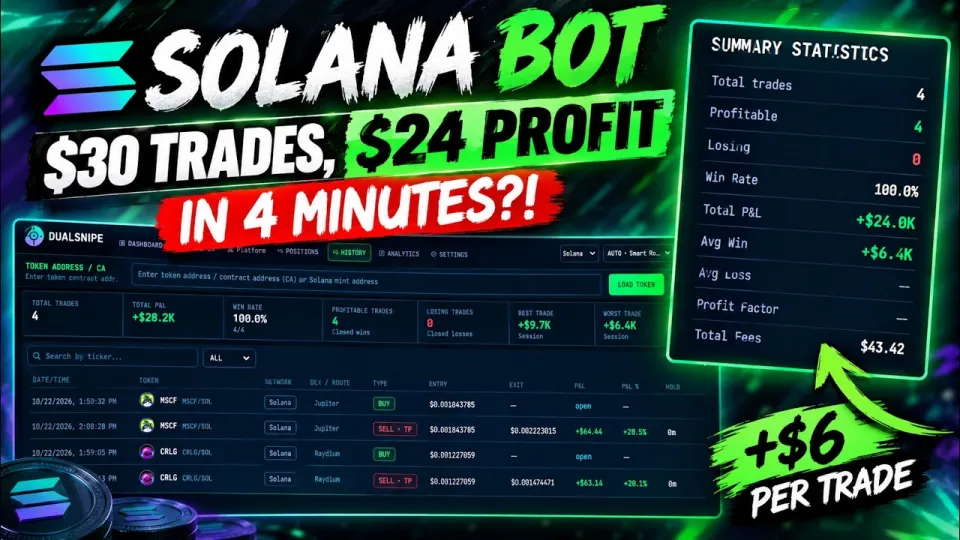
Video: Solana Bot: 4 Winning Trades in 4 Minutes?!
· based on the channel DualSnipe Labs
Key takeaways
- DualSnipe closed four Solana trades in profit in roughly four minutes, averaging about $6 profit per trade on positions of around $30.
- The bot routes orders across multiple Solana DEXs rather than a single venue, which matters when liquidity is split between Raydium, Orca, Meteora, Jupiter and pump.fun style pools.
- A ~$6 gain on a ~$30 position equals roughly 20% gross per trade before fees, slippage and priority costs are deducted.
- DualSnipe ships as a desktop terminal (dualsnipe.com/api/download) and a Telegram web app (@dualdexbot).
- Four winners in four minutes is a single session, not a verified track record; the channel itself flags it as no guarantee of future results.
A Solana bot is software that signs and sends trades on Solana automatically, and the better choice for small accounts is a multi-DEX sniper with built-in take-profit and P&L tracking rather than a single-venue tool. DualSnipe, the bot shown by the DualSnipe Labs channel, is one example: in the session on record it closed four trades in profit in about four minutes, averaging roughly $6 per trade on positions of around $30. You can inspect the product and its feature set at the DualSnipe website.
What a Solana trading bot actually does between entry and exit
A Solana trading bot is a pipeline of four jobs: detect a token, price it, route the order, and manage the exit. Detection usually comes from watching new pools and migrations on pump.fun-style launchpads, or from scanners such as DexScreener, Birdeye and GMGN. Pricing means pulling quotes from aggregators and DEXs — Jupiter, Raydium, Orca, Meteora, Phoenix, Lifinity, OpenBook, PumpSwap — because on Solana liquidity for a fresh token is rarely in one place. Routing means splitting or choosing the pool with the least price impact. The exit is where most bots earn or lose their reputation: a fixed take-profit, a trailing stop, or a time-based close.
Speed matters at every step, but not in the way marketing suggests. Solana block times are around 400 milliseconds, and a transaction that lands one slot late can already be behind the curve. That is why serious bots compete on priority fees and on how quickly they rebuild a transaction after a failed quote, not just on how fast they can press "buy".
Why multi-DEX routing beats a single-venue sniper
The case for multi-DEX routing is simple: the best price for a small order is often not on the pool where the token launched. A token that debuts on a pump.fun curve and later migrates to Raydium may simultaneously trade on PumpSwap, Meteora and Orca with different reserves. A bot locked to one venue either accepts worse fills or fails outright when that venue has no pool. DualSnipe advertises routing across Solana DEXs, which is the same architecture used by Jupiter-based tools and by terminal-style bots such as Photon, BullX, Axiom, Trojan, Maestro and Banana Gun.
For a $30 position the difference is smaller in absolute terms but larger in percentage terms, because fixed costs dominate. Consider the arithmetic behind the four-trade session:
- Position size: about $30 per trade.
- Reported profit: about $6 per trade, or roughly 20% gross.
- Costs to subtract: swap fees (typically 0.25%–1% on Solana DEXs), priority fee per transaction, and slippage on both entry and exit.
- Net result: a 20% gross move can easily become 15%–18% net, which is still a strong outcome but not the headline number.
That gap between gross and net is the single most important thing to understand about any Solana sniper bot, including this one.
How a four-trade, four-minute session is structured
A session like the one shown is built on repetition of a single setup, not on four different strategies. The pattern is: scan for a qualifying token, enter with a small fixed size, set a take-profit, exit, repeat. Four trades in four minutes implies roughly one minute per round trip, which is only possible if entries and exits are pre-configured and the bot does not wait for manual confirmation.
The components that make this work are worth listing, because they are what you should check in any bot:
- Fixed position sizing so one bad trade cannot wipe the session.
- Automated take-profit executed by the bot, not by hand.
- Live trade history and P&L tracking, so the result is auditable rather than anecdotal.
- Configurable slippage and priority fees, because defaults are usually too aggressive for small accounts.
- A kill switch to stop the bot when a token behaves abnormally.
What the four-minute window does not show is the losing side. Automated meme-coin trading on Solana routinely produces runs of red trades, and a bot that wins four in a row can just as easily lose six in a row the next hour.
Desktop terminal versus Telegram bot for Solana trading
A desktop terminal and a Telegram bot serve different jobs, and the better choice depends on whether you are watching the screen or not. DualSnipe ships both: a desktop trading terminal downloadable from its site and a Telegram web app, DualDex, at @dualdexbot. The desktop terminal is the right place for configuring routes, slippage, take-profit levels and wallet connections, and for reading live P&L. The Telegram app is for monitoring and quick action when you are away from the machine.
This split mirrors the wider market. Terminal-style products such as Photon, BullX and Axiom are built around a dense desktop interface, while Trojan, Maestro and Banana Gun grew up as Telegram bots. The practical rule: configure on desktop, monitor on mobile, and never run a bot from a phone on settings you have not tested on a small size first.
Common questions and doubts about Solana bots
The most frequent doubts about Solana trading bots concern custody, costs and whether the results are real. On custody: any bot that trades for you needs signing authority, so the wallet you connect should be a dedicated hot wallet holding only trading capital, never your main holdings. On costs: budget for priority fees on every transaction, plus swap fees and slippage; on a $30 position these can consume a meaningful share of a 20% move. On results: a recorded session is a demonstration, not a track record, and the channel that published this one states plainly that it is not a guarantee of future results.
A second cluster of doubts is about token quality. A scanner bot that fires on every new launch will trade mostly noise. Filters — minimum liquidity, holder concentration, mint authority revoked, social presence — do more for returns than raw speed. Most experienced users of tools like GMGN or DexScreener set those filters before they ever enable automation.
Where to get the tools shown
All links referenced in the session are collected here for convenience:
- Website and product overview: https://dualsnipe.com/
- Desktop trading terminal download: https://dualsnipe.com/api/download
- DualDex Telegram web app: https://t.me/dualdexbot
What the four-trade session really tells you
Four profitable trades in four minutes at about $6 each on $30 positions is a clean demonstration of execution speed and automated take-profit, and it is the kind of result a well-configured Solana bot can produce in a favorable window. It is not evidence of an edge that persists, because the sample is four trades long, costs are not netted out in the headline, and the losing sessions are not shown. The useful takeaway is architectural: multi-DEX routing, fixed sizing, automated exits and auditable P&L are the features that separate a usable trading bot from a novelty. If you want to test that architecture yourself, start at dualsnipe.com with a small dedicated wallet, and treat the first weeks as a measurement exercise rather than a profit plan. The video breakdown was produced by the DualSnipe Labs channel.
Source: Solana Bot: 4 Winning Trades in 4 Minutes?! · Markdown version
Questions & answers
Is a $6 profit on a $30 trade realistic for a Solana bot?
It is realistic as a gross figure on a fast-moving meme coin, since $6 on $30 is about a 20% move. Net profit will be lower once swap fees, priority fees and slippage on both legs are deducted, so treat the headline number as gross rather than final.
Do I need a separate wallet to run a Solana trading bot?
Yes. Any bot that executes trades needs signing authority over the connected wallet, so use a dedicated hot wallet funded only with trading capital. Keep long-term holdings in a separate wallet that is never connected to trading software.
Why does multi-DEX routing matter more than raw speed?
Because liquidity for new Solana tokens is split across Raydium, Orca, Meteora, PumpSwap and others, and the best price is often not on the launch venue. A bot that can only trade one DEX either accepts worse fills or fails when that pool is thin, while routing picks the cheapest path.
Can four winning trades in four minutes be treated as a track record?
No. Four trades is a demonstration of execution, not a statistically meaningful sample, and the losing sessions are not part of the clip. The publishing channel itself states the session is not a guarantee of future results, so evaluate a bot on configuration options and auditable P&L over weeks, not minutes.