How Can a Meme Coin Trade Turn a Small Bankroll Into Five Figures?
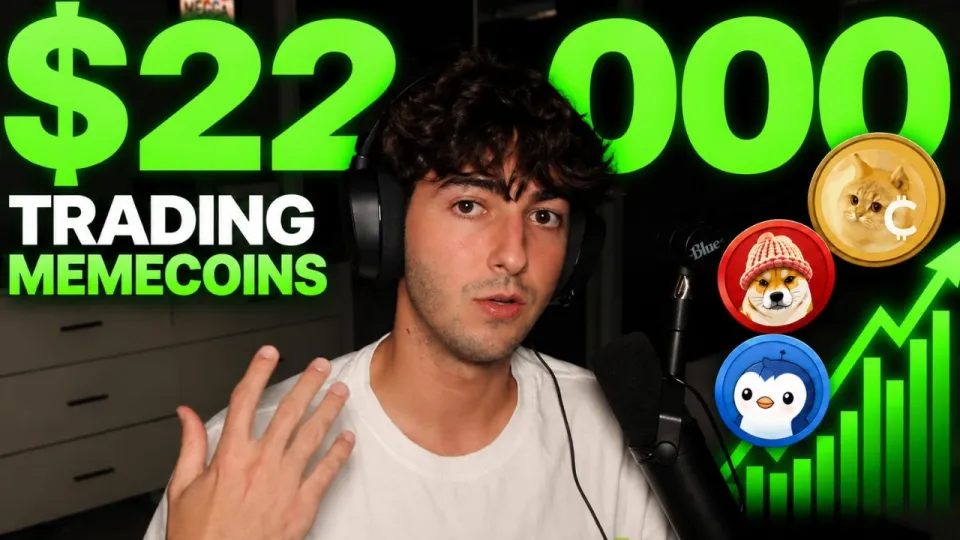
Video: How I Made $22,000 in a SINGLE Memecoin Trade (FULL GUIDE)
Need articles like this for your video? They help promote it on YouTube and Google — order them in the Telegram bot @sat_sit_bot. Articles with your video embedded are written and posted by the bot itself — on popular topical sites (no ads). Your first 50 articles are free.
· based on the channel Megga
Key takeaways
- Megga's guide walks through a single meme coin trade that produced roughly $22,000 in profit.
- The setup starts with a dedicated hot wallet funded with only the amount the trader can afford to lose.
- Entries are taken early in a token's life, before mainstream listings and influencer attention.
- Profit is protected with staged exits: partial sells on the way up and a hard stop on the remainder.
- The strategy depends on speed, on-chain research and tolerance for near-total losses on failed picks.
A meme coin trade can realistically turn a few hundred dollars into five figures, but only when the trade is treated as a high-risk speculation with a fixed budget, an early entry and pre-planned exits. In his full guide, the creator Megga walks through one such trade that ended around $22,000 in profit, and the value of the walkthrough is less in the number than in the sequence: wallet setup, early discovery, sizing, and selling into strength before the crowd arrives. Beginners who want the structured version of that process can start with the free beginners guide at the Wiredd trading course.
What does a $22,000 meme coin trade actually look like?
The trade is a single position in a newly launched token, entered while liquidity is thin and the chart has almost no history, then scaled out as buyers arrive. Three things separate this from gambling:
- A dedicated hot wallet is created for meme coins only, funded with a small amount of SOL or ETH that the trader is fully prepared to lose.
- The token is found early, typically through on-chain trackers and wallet alerts rather than through social media trending lists.
- The exit is decided before the buy: partial sells at set multiples, and a stop on the rest if momentum dies.
That structure matters because meme coins have no cash flow, no earnings and no fundamentals to anchor a price. The entire move is driven by attention and liquidity, which means the same setup can produce a five-figure result or a near-total loss depending on timing. The $22,000 figure reflects one outcome of a repeatable process, not a typical result.
How do you find a meme coin before the crowd?
Early discovery is the core skill, because by the time a token is visible on mainstream dashboards the easy part of the move is usually gone. Traders who consistently get in early work from a short list of sources:
- Launch monitors that flag new pairs the moment liquidity is added, filtered by minimum liquidity and holder count.
- Wallet alerts on known profitable addresses, so a new buy from a tracked wallet triggers a notification within seconds.
- Community channels where launch news spreads before it reaches aggregators, which is exactly the advantage critics point to when they argue that insiders and connected traders get a head start.
Filters do real work here. A token with a handful of holders, unlocked liquidity or a contract that lets the deployer mint new supply is a loss waiting to happen. Checking whether liquidity is locked, whether the top wallets are controlled by one entity, and how concentrated the holder base is takes a couple of minutes and removes most obvious traps.
Position sizing and risk rules for meme coin speculation
The budget rule is simple: money sent to a meme coin wallet should be money whose loss changes nothing about your finances. A practical framework looks like this:
- Fund the hot wallet with a fixed amount, for example a few hundred dollars, and never top it up mid-trade out of frustration.
- Cap any single position at a fraction of that wallet so one failed launch does not end the session.
- Take the initial investment off the table once a token doubles or triples, then let the remainder run.
- Accept that a high share of picks will go to zero; the winners have to be large enough to cover the losers.
This is where most beginners break. A token drops 60%, they add more, and a speculative bet becomes a serious loss. The traders who survive long enough to catch a five-figure move are the ones who treat each launch as one of many lottery tickets with a defined price.
How to take profit without killing the upside
Selling is the part that decides whether a good entry becomes real money. A staged exit works better than a single all-or-nothing sell:
- Sell a portion at the first meaningful multiple to recover the initial capital.
- Sell another portion into a spike in volume or a listing announcement, when buyers are most aggressive.
- Keep a small remainder with a trailing stop in case the token keeps running.
- Exit the rest immediately if liquidity starts draining or the deployer wallet moves tokens.
Slippage and fees eat into results on thin pairs, so checking the route before confirming a large sell is part of the process. On a fast pump, a market sell into shallow liquidity can fill far below the quoted price.
The uncomfortable questions about influencer meme coin trades
Any large meme coin win posted publicly attracts fair skepticism, and the doubts are worth addressing directly. The most common ones:
- Was the trade possible without a following? A creator with an audience can move attention to a token simply by mentioning it, which is an advantage an anonymous trader does not have. The mechanics of the trade can be copied; the distribution cannot.
- Is the win verifiable? Screenshots of portfolio values are easy to stage. On-chain wallet history is not, so a public wallet address is the only real proof.
- Are viewers being set up as exit liquidity? If a creator buys before announcing, followers buying afterwards are the buyers for that position. That is the structural risk behind every "I made X on this coin" video.
- What about smaller challenges? Turning $25 to $100 into $1,000 is a more honest test of skill than a single lucky launch, because it forces consistent process rather than one outlier.
None of this makes the strategy fake. It does mean the honest framing is: here is a method that can work, executed by someone with tools, speed and an audience, in a market where most participants lose.
Tools and links from the breakdown
All resources referenced in the guide, in one place:
- Free beginners guide and trading course: https://whop.com/wiredd
- Trading terminal used for execution: https://trade.padre.gg/rk/megga
- Live streams: http://www.twitch.tv/megga
- Short-form clips: https://www.tiktok.com/@meggafaze
- Updates and commentary: https://twitter.com/megga
A trading terminal matters more than it sounds: routing, slippage settings and speed of execution decide whether an early entry is actually filled at the price on screen.
Final takeaway
A $22,000 meme coin trade is a demonstration of process, not a promise of income: a small dedicated wallet, early on-chain discovery, strict position sizing, staged profit-taking and an honest acceptance that most picks fail. Megga's breakdown is useful precisely because it shows the full sequence rather than just the profit screenshot, and the same free beginners guide linked at the start is available here: start the Wiredd beginners course. Treat every launch as a speculation with a fixed cost, verify wallets on-chain rather than trusting screenshots, and size positions so that being wrong is survivable.
Source: How I Made $22,000 in a SINGLE Memecoin Trade (FULL GUIDE) · Markdown version
Questions & answers
How much money do you need to start trading meme coins?
You can start with a few hundred dollars, and many traders deliberately keep the meme coin wallet small. The point of a small bankroll is that a total loss on a launch does not affect your finances. Position sizing, not the size of the starting amount, determines whether you survive long enough to catch a large move.
Can a beginner realistically repeat a $22,000 meme coin trade?
It is possible but not typical. Large wins usually combine an early entry, thin liquidity and a wave of attention that a trader with an audience can help create. A beginner can copy the mechanics, such as wallet setup, filters and staged exits, but should expect most positions to fail and treat any large win as an outlier.
How do you avoid meme coin rug pulls?
Check whether liquidity is locked, how concentrated the holder base is, and whether the contract allows the deployer to mint or freeze tokens. Exit immediately if the deployer wallet starts moving tokens or liquidity drains. No checklist removes the risk entirely, so only trade amounts you can afford to lose.
When should you sell a meme coin position?
Most experienced traders sell in stages: a portion early to recover the initial capital, another portion into a volume spike or listing news, and a small remainder with a trailing stop. Decide these levels before buying, because during a fast pump or dump there is no time to think clearly.